
Grace, Design, and the Local Church: Understanding the Complementarian View of Pastoral Roles
WEEKLY BLOGSMINISTRY
6/12/20264 min read

When we talk about church leadership and who is called to the role of pastor, it’s easy for the conversation to feel heavy or even divisive. In our world today, we’re taught that for two people to be equal, they have to do the exact same things. But when we dive into scripture and look at how God structured the Church, we find a beautiful blueprint where equality doesn't mean sameness—it means harmony.
The perspective that the office of pastor or elder is reserved for men is called complementarianism. It’s the belief that men and women are created with absolute equality in dignity, value, and inheritance in Christ, but are given distinct, intentional roles that complement one another in the family and the church.
If you’ve ever wondered about the biblical foundation for this traditional view, let’s open up the Word and look at a few key passages together using the New International Version (NIV).
1. Rooted in Creation: 1 Timothy 2
One of the most direct places we see this discussed is in Paul’s first letter to Timothy. He gives instructions for how the church family should function when they gather together:
"A woman should learn in quietness and full submission. I do not permit a woman to teach or to assume authority over a man; she must be quiet." — 1 Timothy 2:11–12 (NIV)
At first glance, this language can feel jarring to modern ears. But to understand Paul’s heart here, we have to look at whyhe says this. He isn’t basing his argument on a temporary cultural issue in Ephesus, like uneducated women or local gossip. Instead, he anchors his reasoning in history and creation itself:
"For Adam was formed first, then Eve. And Adam was not the one deceived; it was the woman who was deceived." — 1 Timothy 2:13–14 (NIV)
By pointing all the way back to Genesis, Paul shows us that male leadership in the church isn't a modern cultural invention or a fallback plan—it’s grounded in God’s original, pre-fall design for humanity. Just as God established a pattern of spiritual leadership in the home, He carries that same beautiful order into the household of faith.
2. The Blueprint for Leadership: 1 Timothy 3 & Titus 1
In the New Testament, the roles of "pastor," "elder," and "overseer" are used interchangeably to describe those called to lead, protect, and teach the local church. When Paul lays out the specific qualifications for these leaders, the language he uses is incredibly intentional.
"Now the overseer is to be above reproach, faithful to his wife, temperate, self-controlled, respectable, hospitable, able to teach..." — 1 Timothy 3:2 (NIV)
He echoes this in Titus 1:6, noting that an elder must be "a man whose life is above reproach, faithful to his wife."
The original Greek phrase here literally means a "one-woman man." While this qualification is deeply focused on moral purity and character, the wording inherently envisions a male occupant for this specific governing office. God isn't looking for the most charismatic person in the room; He establishes a specific order for who carries the weight of this spiritual authority.
3. Peace and Order in Worship: 1 Corinthians 14
God is a God of peace, not confusion, and He cares deeply about how His church functions when it comes together. In his letter to the Corinthians, Paul addresses orderly worship:
"Women should remain silent in the churches. They are not allowed to speak, but must be in submission, as the law says." — 1 Corinthians 14:34 (NIV)
Context is everything here. We know from 1 Corinthians 11 that women were actively praying and prophesying in the early church—their voices were vital! So, the "silence" Paul is referring to in chapter 14 specifically targets the authoritative judging of prophecy and doctrine. Women are invited to be an active part of the body, but the final, authoritative weight of doctrinal oversight belongs to the elders.
Equal Worth, Different Strengths
It is so important to emphasize that restricting the office of pastor to men has zero to do with a woman's intelligence, spiritual maturity, or value. Scripture could not be clearer that men and women stand on completely level ground at the cross:
"There is neither Jew nor Gentile, neither slave nor free, nor is there male and female, for you are all one in Christ Jesus." — Galatians 3:28 (NIV)
This beautiful verse reminds us that we share an equal inheritance of salvation. Our value is identical, but our functions are different. Think of the Trinity: God the Father and God the Son are completely equal in divinity, yet they have distinct, harmonious roles in the story of redemption.
Women in the New Testament were absolute powerhouses for the gospel. Phoebe was a deacon who served the church faithfully (Romans 16:1), Priscilla worked right alongside her husband to help instruct Apollos in the faith (Acts 18:26), and older women are explicitly commanded to mentor and pour into younger women (Titus 2:3–4).
Final Thoughts
Holding to a complementarian view isn’t about holding women back or dimming their gifts. It’s about honoring Biblical authority and stepping into the unique lanes God designed for us. When we lean into the distinct roles He created, the Church functions as a healthy, thriving body—powerfully serving others and reflecting the intentional heart of our Creator.
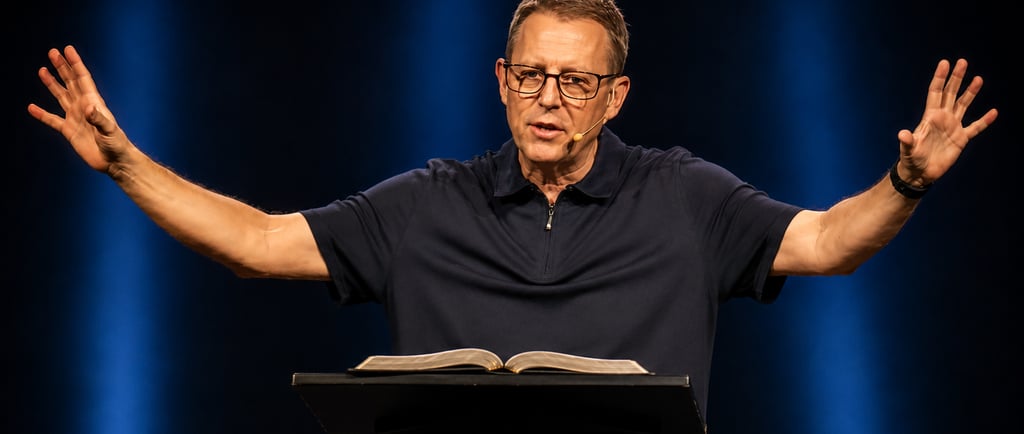
My dad, Pastor Tim Hill, preaching one Sunday morning at Bear Creek Baptist Church
Connect
Join the journey with faith and hope
kaitlin@frontierfaith.org
© 2026. Created by Salt & Stone Web Design. All rights reserved.